
☎ (586) 500-7647
| 47766 Van Dyke Ave, Shelby Township, MI 48317
An alternative to traditional fillings and crowns
When a tooth has decay or damage that is too extensive for a simple filling but not severe enough to require a full dental crown, inlays and onlays offer the ideal middle ground. At Roam Dental in Shelby Township, Dr. Barbu uses precision-crafted porcelain inlays and onlays to restore damaged teeth with maximum conservatism — preserving more of your natural tooth structure while delivering a restoration that is stronger, longer-lasting, and more aesthetically pleasing than a traditional filling.
On This Page
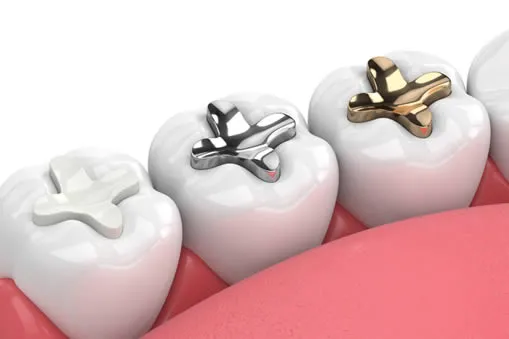
Dental inlays and onlays are custom-fabricated restorations made from porcelain, composite resin, or gold that are bonded directly to a damaged or decayed tooth. An inlay fits within the grooves of the tooth — between the cusps — much like a puzzle piece. An onlay extends further, covering one or more of the cusps to restore a larger area of the biting surface.
Both restorations are considered more conservative than a full dental crown, which requires removing significantly more tooth structure. Inlays and onlays allow Dr. Barbu to preserve as much of your healthy natural tooth as possible while still providing a strong, durable, and decay-resistant restoration. They are far more durable than standard fillings and can last 10–30 years with proper care.
Porcelain inlays and onlays are particularly popular because they can be precisely shade-matched to your natural teeth, making the restoration virtually invisible. The material is also highly resistant to staining and mimics the translucency of natural tooth enamel for a seamlessly beautiful result.
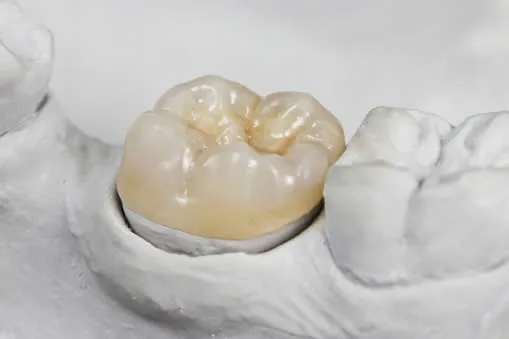
The choice between a filling, inlay, onlay, or crown depends on the size and location of the damage. A filling is ideal for small areas of decay. An inlay is used when decay or damage occupies the central portion of the tooth between the cusps. An onlay — sometimes called a "partial crown" — is appropriate when one or more cusps are affected and need to be reinforced or replaced.
A full crown is reserved for situations where a tooth is severely damaged, has undergone a root canal, or requires full structural support. Dr. Barbu always recommends the most conservative option that will adequately restore the tooth — choosing an inlay or onlay over a crown whenever the clinical situation allows, to preserve more of your healthy natural tooth structure.
During your examination, Dr. Barbu will evaluate the extent of decay or damage, discuss your options, and recommend the restoration that will provide the best long-term outcome for your tooth. Our goal is always to restore function, strength, and aesthetics in the most minimally invasive way possible.

Getting an inlay or onlay at Roam Dental is a two-visit process. At your first appointment, Dr. Barbu removes all decay from the tooth, shapes it to receive the restoration, and takes a precise impression. A temporary restoration is placed to protect the tooth while your custom inlay or onlay is crafted by a dental laboratory to the exact specifications of your tooth.
At your second visit — typically one to two weeks later — the temporary is removed, the permanent inlay or onlay is tried for fit and occlusion, and then bonded permanently to the tooth using a strong dental adhesive. The result is a restoration that integrates seamlessly with your tooth, restoring its original strength and function. Porcelain options are shade-matched to blend naturally with your surrounding enamel.
After placement, you can care for your inlay or onlay exactly as you would natural teeth — regular brushing, flossing, and twice-yearly visits to Roam Dental. With proper care, most porcelain inlays and onlays last well over a decade. Schedule your appointment today to find out if an inlay or onlay is the right restoration for your tooth.
Inlays and onlays deliver the durability and aesthetics of a crown with the conservatism of a filling — the best of both worlds for moderately damaged teeth.
Inlays and onlays remove only the damaged portion of the tooth, preserving significantly more healthy enamel than a full crown preparation requires.
Laboratory-fabricated inlays and onlays are significantly stronger and more durable than direct composite or amalgam fillings, especially for larger restorations.
Porcelain inlays and onlays are shade-matched to blend invisibly with surrounding enamel, delivering a restoration that looks completely natural.
Each inlay or onlay is custom-fabricated from a precise impression of your tooth, ensuring a perfect fit that prevents gaps where bacteria could enter.
With proper oral hygiene, porcelain inlays and onlays can last 15–30 years — far exceeding the lifespan of conventional composite fillings.